


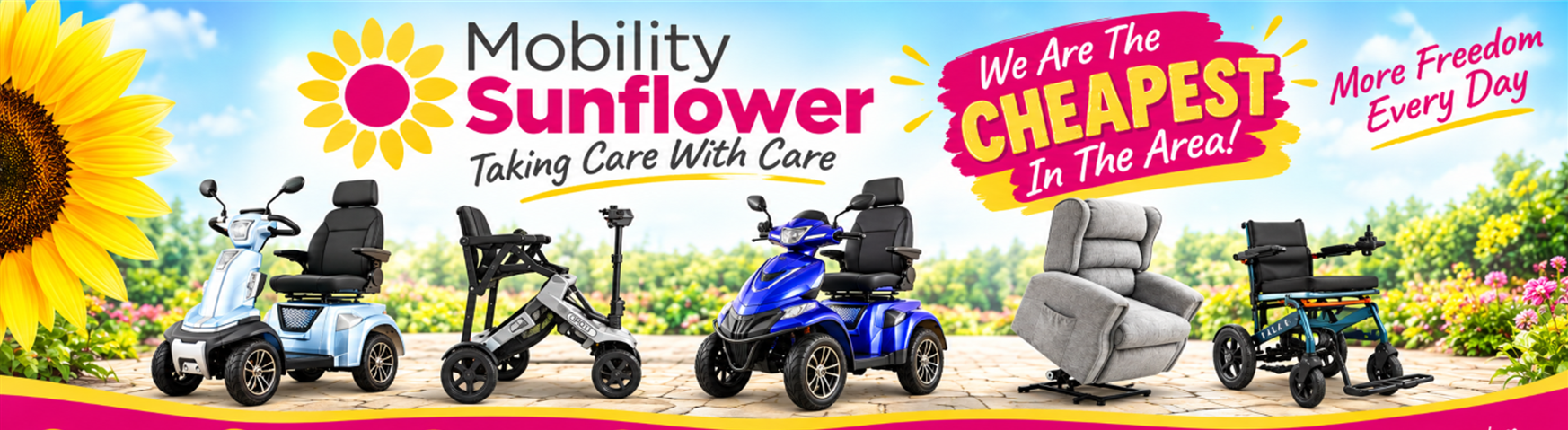
Wheelchair Buying Guide
Find the Right Wheelchair for You
Choosing the right wheelchair is about more than price. It’s about finding a chair that suits your mobility, lifestyle and how you plan to use it.
At Mobility Sunflower in Stewarton, we have over 34 years of combined mobility experience. So, whether you need a wheelchair for occasional trips, everyday use or simply extra support when you’re out and about, we’re here to help you make the right choice.
Which Wheelchair Is Right for You?
Lightweight & Folding
Ideal if you regularly travel by car, go on holiday or need a wheelchair that’s easy to store and transport.
Transit Wheelchairs
Perfect when someone else will usually be pushing you, such as a family member or carer.
Self-Propelled Wheelchairs
Designed for greater independence, with larger rear wheels allowing you to propel yourself.
Why Choose Mobility Sunflower?
With so many wheelchairs available, choosing the right one can be confusing. That’s why we offer honest, expert advice without the pressure to buy.
Better still, our FREE, no-obligation home visit allows you to try suitable equipment in your own home, helping you make your decision with confidence.
Don’t Buy the Wrong Wheelchair
Come and see Dan & Natalie in Stewarton, or book your FREE home visit today.
The right wheelchair can make a real difference to your independence. Let us help you find yours.
Manual Wheelchairs
-
Orbit Self Prpelled
Original price was: £330.00.£275.00Current price is: £275.00. -
Orbit Transit
Original price was: £330.00.£275.00Current price is: £275.00. -

sunlight
£495.00 -
Wisp Self Propelled
Original price was: £345.00.£299.00Current price is: £299.00. -
Wisp Transit
Original price was: £345.00.£299.00Current price is: £299.00.


Powered Wheelchairs
-

iM.2
£1,995.00 -

Vala
£3,195.00 -
Vala Ultima
Original price was: £3,950.00.£3,450.00Current price is: £3,450.00.

Our manufactures are world leaders in the industry
Buying Guild
To choose the right wheelchair, you must first determine your propulsion needs (self-propelled vs. attendant-propelled) and then calculate your exact body measurements to ensure proper fit, comfort, and safety.
- Self-Propelled: Features large 24-inch rear wheels with handrims. Best for users with sufficient upper body strength who want independence.
- Attendant-Propelled (Transit): Features smaller rear wheels. Designed strictly for a caregiver or companion to push the occupant.
- Electric/Power Chairs: Operated via a joystick controller. Ideal for users lacking upper body strength who still require independent indoor or outdoor mobility.
Step 2: Measure for the Right Size
Accurate measurements prevent pressure sores, support posture, and ensure the chair fits through doorways.
- Seat Width: Measure the widest part of the hips or thighs while seated, then add 1 to 2 inches (2.5 to 5 cm) for clothing clearance.
- Seat Depth: Measure from the back of the hips to the back of the knee, then subtract 1 to 2 inches to prevent the seat fabric from cutting into the back of the knees.
- Seat Height: Measure from the sole of the foot to the back of the thigh. Deduct the thickness of your chosen pressure cushion to find the exact floor-to-seat frame height.
- Armrest Height: Relax the shoulders and measure from the seat surface to the elbow. Add 1 inch for natural support without forcing the shoulders to shrug.
Step 3: Evaluate Lifestyle and Practical Features
- Weight Capacity: Check the chair’s safe working load. Ensure user weight plus carried items fall well under the limit (standard chairs support up to 100 kg; bariatric models support more).
- Portability: Choose a lightweight aluminium folding frame if the wheelchair must be lifted frequently into a car boot. Avoid heavy steel frames.
- Environment: Select grooved tires for outdoor traction and smooth tires for indoor floors. Check the total exterior width of the wheelchair against your home’s narrowest doorways.
- Vehicle Safety: If the occupant will remain seated in the wheelchair while riding in a taxi or mobility vehicle, verify the model is explicitly labeled as crash-tested (ISO 7176-19 compliant).
If you would like to narrow down specific models, please tell me:


